
JUNE EOFY Release

Welcome to our EOFY drop for 2026!
Our 15% off sitewide has now gone live, and there's almost 250 new and restocked pieces in this release. During our sales periods stock sells out within minutes, so be quick and we hope you snap up something you like!
Sort by:


The Benriner is the industry standard for mandoline slicers. Made in Japan, it features sharp, adjustable sainless steel blades that create paper-thin slices and perfect julienne cuts.
Total width: 90mm
Total length: 315mm
With three interchangable blades included, choose from fine, medium, and coarse cuts. Compact, durable, and essential for precise vegetable prep.
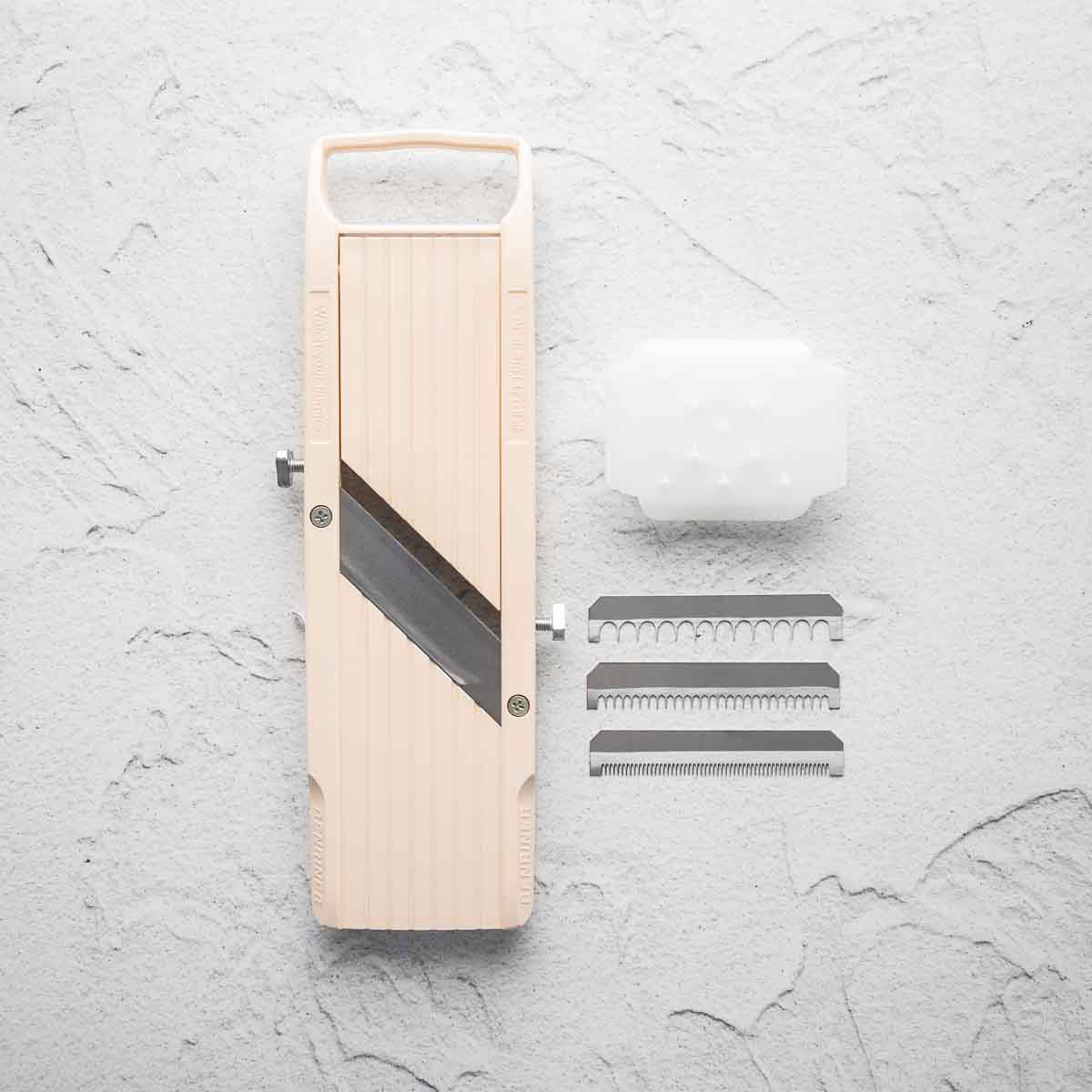

This Slicer by Benriner is exactly what you would expect from a high-quality Japanese mandoline. Crafted with stainless steel blades that are extremely sharp, watch your fingers!
Total width: 90mm
Total length: 315mm
This mandoline is lightweight and adjustable, we will perfectly slice, cut, and julienne vegetables for salads with precision. Comes with three interchangeable blades - fine, medium, and coarse.


Embrace handmade.
Shirt Specs
AS Colour Staple
Regular fit
Crew neck
Mid weight, 180 GSM, 28-singles
100% combed cotton (marles 15% viscose)
Neck ribbing, side seamed, shoulder to shoulder tape, double needle hems, preshrunk to minimise shrinkage

Cleaver enamel pin for your knife roll, shirt, or apron!
About 2cm in size.

Higonokami Enamel Pin for your knife roll, shirt, or apron!
About 2cm in size.

Whale knife Enamel Pin for your knife roll, shirt, or apron!
About 2cm in size.

Whetstone Enamel Pin for your knife roll, shirt, or apron!
About 2cm in size.


Set of 4 of our second batch of enamel pins. Each about 2cm in size.


The complete set of 8 enamel pins, comes with:
- Cleaver
- Mandoline
- Higonokami
- Chef's Edge Monogram
- Hibachi
- Whetstone
- Bunka
- Whale Knife


Chopstick Tongs
| full length | 27.5cm |
|---|---|
| Handle width | 1.0cm |
| Tip width | 0.5cm |
| Maximum opening width | 10.0cm |
| weight | 41g |
| Material | SUS821L1 |
| Surface treatment | Black Oxidation |
About Fujita Kinzoku
Fujita Kinzoku has been crafting pots, pans, cups, and other everyday kitchenware in Japan since 1951. Three generations of skill in molding, pressing, and spinning metal sit behind each piece, now shaped with the help of modern tools like NC machines and laser cutters. Run today by three brothers, they produce everything in-house, turning out cookware that's built to last and made to bring a little pleasure to daily life.


Ladle
| full length | Approximately 23cm |
|---|---|
| width | Approximately 8cm |
| depth | Approximately 8cm |
| weight | 82g |
| Material | SUS821L1 |
| Surface treatment | Hard tempering |
| Surface treatment | Black Oxidation |
About Fujita Kinzoku
Fujita Kinzoku has been crafting pots, pans, cups, and other everyday kitchenware in Japan since 1951. Three generations of skill in moulding, pressing, and spinning metal sit behind each piece, now shaped with the help of modern tools like NC machines and laser cutters. Run today by three brothers, they produce everything in-house, turning out cookware that's built to last and made to bring a little pleasure to daily life.


Turner (Spatula)
| Full length | Approximately 31cm |
|---|---|
| Width | Approximately 8cm |
| Depth | Approximately 10cm |
| Weight | 77g |
| Material | SUS821L1 |
| Surface treatment | Hard tempering |
| Surface treatment | Black Oxidation |
About Fujita Kinzoku
Fujita Kinzoku has been crafting pots, pans, cups, and other everyday kitchenware in Japan since 1951. Three generations of skill in moulding, pressing, and spinning metal sit behind each piece, now shaped with the help of modern tools like NC machines and laser cutters. Run today by three brothers, they produce everything in-house, turning out cookware that's built to last and made to bring a little pleasure to daily life.


| Material | Palm fiber, stainless steel, beech |
|---|---|
| full length | 19cm |
| height | 3.5cm |
| weight | 45g |
This product was developed as a joint project between Takada Kozo Shoten, a scrubbing brush specialty store founded in 1948, Fujita Metal, and Kinki University. Based on the theme of "making tools" that are close to daily life and accompany our eating habits, we carefully select palm fibers and have each brush manufactured by hand by skilled craftsmen.


01 Silver is built with a single tablespoon volume (half ounce) to scale recipes and ratios with consistency. The well is deeply formed to cradle liquid, the tip is tapered to a fine point for precise pouring or basting. The handle is long enough to stir a braise or a pot of beans, and nimble enough to sauce a plate. The lip is thin and flared to help scrape the corners of a pan or storage container.
Form-
Inspired by the worn and tarnished steel often found at flea markets, and modeled after old American and European silhouettes the spoon is tumbled and unpolished. This creates a matte and imperfect material finish. Each piece is stamped and etched, then finished by hand on a lathe in Mr. Okada’s workshop.
Origin-
Niigata, Japan
Material-
18/10 Japanese stainless steel
Length-
9 inches
Cleaning-
Hand-wash only, please.
Packaging-
Packaging is constructed with recycled chipboard


This glimmering scepter is a secret weapon in pro kitchens the world over. If you’ve ever wondered how restaurants consistently nail temps on meat, fish, and baked goods the humble cake tester is your answer. A meat thermometer provides an accurate but detached numerical answer, the cake tester offers an opportunity to cook intuitively. To use your senses and be more connected to your food. To understand what medium-rare feels like, not what a digital probe tells you. If you treat this battle sword well, you may not need to buy another cake tester again.
Form-
A cake tester that doesn’t melt, snap, or separate. Noyau is built with tough Japanese steel, a more fitting material than the polyurethane often used by manufacturers. Taking inspiration from cocktail pins found at bars and antique shops in Kyoto, Noyau's head is stamped flat to feel like a weighted guitar pick, and pinched at the base to keep the rod firmly in place. The tip is pointed, to mimic a toothpick and slide through meat, fish, cake, and veg without damaging flesh, fiber, or crumb.
Origin-
Niigata, Japan
Material-
18/8 Japanese stainless steel
Length-
5.5 inches
Cleaning-
Hand-wash only, please.
Handling-
Noyau's tip is sharp out of the box, please use with caution. If you would like it less sharp, a few passes on medium-grit sandpaper or something similar will do the trick.
Packaging-
Little pink box constructed with recycled chipboard
Doneness Guide:
Insert skewer in center from side, should feel like sliding through butter. If there is any resistance, cook longer - you are poking through uncooked fibers.
Insert skewer in thickest area, hold for a few moments, remove and test on lower lip or inner wrist. Just below skin temp = Rare. Slightly warm = Med Rare. Almost hot = Medium. Hot to the touch = Well-Done.
Insert skewer in thickest area of thigh/breast. Hold for a few moments, remove and test. Should feel hot to the touch.
Use in place of toothpick.
If there is any resistance, cook longer. Should feel soft siding through.
Insert skewer in center from top. Hold for a moment. Remove and test.
Chef's Edge
We pride ourselves on offering an unparalleled selection of Japanese knives. From the versatile Gyuto and the precise Santoku to specialized knives like the Nakiri and Yanagiba, each knife is handpicked for its quality and performance.